Standing Water in a Warner Robins Back Yard: Why the Clay Holds It and What Fixes It
A yard that stays soggy three days after rain usually has a soil problem, not a rain problem, and the fix depends on which way the ground actually falls.
August 26, 2026 · 3 min read
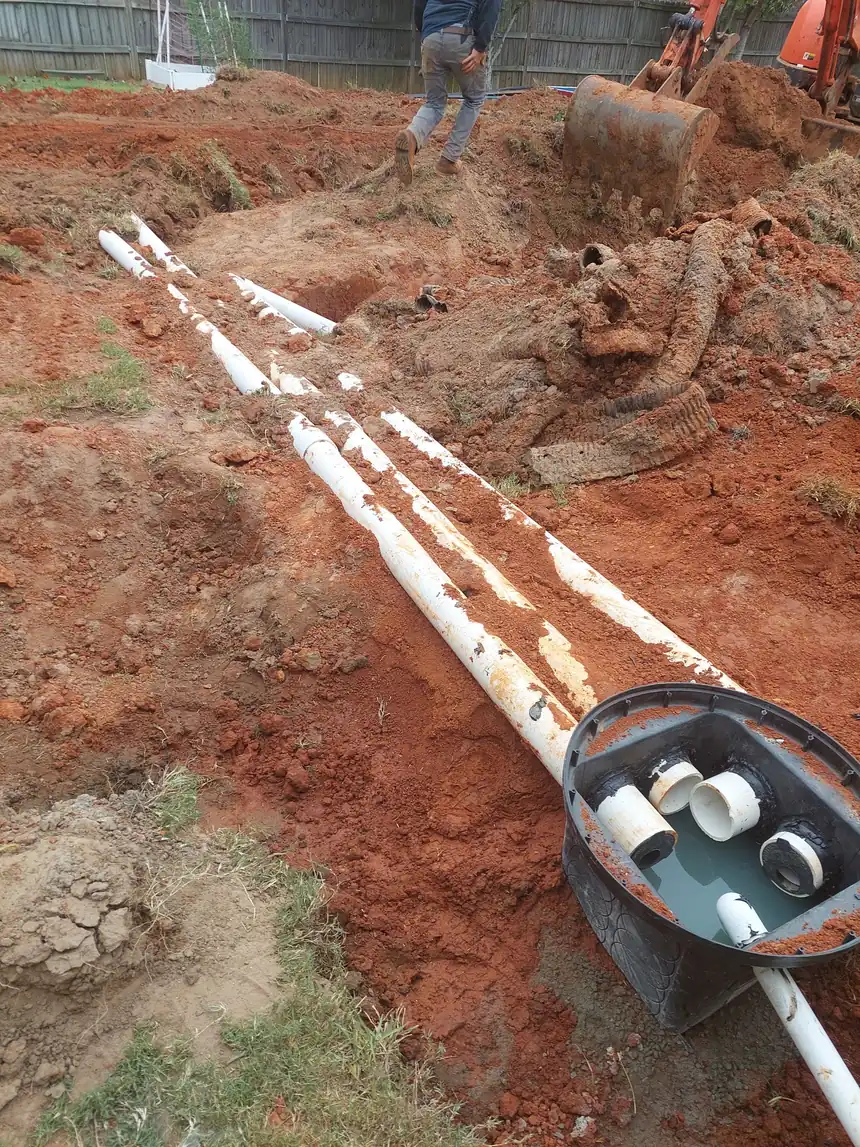
Walk out to a low corner of the yard two or three days after a storm and press a boot heel into the grass. If it squelches, that is not bad luck. Houston County sits on red clay, and clay does not drain the way sandy or loamy soil does. The particles are small and packed tight, so water has almost nowhere to go once the top few inches are saturated. It sits. It kills grass roots from underneath. It breeds mosquitoes. And it usually gets worse every year, because a wet spot compacts further every time someone mows or walks over it while it is soft.
Grade first, always
Before anyone talks about pipe, the first question is where the ground actually falls. A lot of Warner Robins back yards were graded once, during construction, and never touched again. Twenty years of settling, mulch buildup, and patio additions can flatten a slope that used to carry water away from the house. If the yard has no real fall to begin with, no amount of pipe underground will fix it, because pipe needs a drop to work with. Sometimes the honest answer is regrading a section of lawn a few inches before anything goes in the trench.
When a trenched line is the right call
If there is fall to work with, a trenched drain line is usually the most permanent fix. The idea is simple: cut a channel through the clay, lay perforated or solid PVC pipe at a consistent slope, and give the water a straight path to somewhere it can actually leave, whether that is a street, a ditch, or a low point at the property line. The hard part is not the pipe. It is keeping the slope consistent through Georgia clay that fights every foot of the trench, and tying the line into a distribution basin at the wet end so water spreads out instead of blowing a hole in one spot.
- Fall of at least 1 inch per 10 feet of run, measured, not guessed
- A distribution basin or daylight point that can actually take the volume
- Backfill compacted in layers, not dumped back in loose
- Sod or seed restored so the trench line does not scar the lawn
When a pump is the honest answer
Some yards genuinely do not have anywhere for water to fall to. A back corner sits lower than the street, the fence line, and every neighboring lot, and gravity is not going to solve that no matter how the pipe is angled. That is when a pump system earns its keep: an underground collection point, a sump, and a pump that pushes water uphill and out to a safe discharge point instead of waiting on gravity that was never there. It is more moving parts than a gravity line, which means it is worth doing right the first time rather than patching a shallow fix every spring.
What it looks like once it is buried
This is quiet work by design. Once the trench is backfilled and the sod is laid back down, there should be nothing to see. The test is not how it looks the day it is finished, it is how the yard looks after the next hard rain. A job done right means walking out three days later to dry grass in the spot that used to hold water for a week. That is the whole point, and it is also why photos of finished drainage work look almost boring next to photos of the trench itself. The trench is where the real work happens.
Getting a straight answer on your yard
Every yard in Houston County holds water a little differently depending on the slope, the neighboring lots, and where the house sits relative to the street. There is no single fix that works for every back yard, and anyone who quotes one before walking the property is guessing. F.G Landscaping and Irrigation works this kind of drainage regularly around Warner Robins, from grading and trenched lines to pump systems for yards with no natural fall. If a corner of your yard has been staying wet longer than it should, call (478) 397-0052 and describe what you are seeing. It is usually a quick thing to diagnose in person.
F.G Landscaping & Irrigation, (478) 397-0052
Call (478) 397-0052More articles
Sprinkler Trouble: What You Can Fix Yourself and What Needs a Crew
One broken head is usually a five-minute fix. A zone that will not shut off or a dry corner that never gets wet is a different problem entirely.
Watering a Warner Robins Lawn Through a Georgia Summer Without Wasting It
Short daily watering trains grass roots to stay near the surface, which is exactly the wrong habit for a Georgia summer.